Concept and Inspiration
A thin line of light can make a dark place feel like a new world. Traditional neon lighting sends electricity through low-pressure gas inside a glass tube, making the gas glow. Neon itself is known for its orange light, while other gases and coatings produce a wider range of colors. Glowing tubes can also be bent into letters and pictures, turning a practical sign into something that catches the eye from far away. [1]
Artists took that power of light beyond the storefront. The Light and Space movement emerged in Southern California in the 1960s, with artists exploring how light, scale, and surrounding space change what a person perceives. They worked with fluorescent tubes, neon, glass, and reflective surfaces, sometimes making the viewer's experience of a room central to the artwork. [2] In a colorful light installation, even a plain wall can become part of the scene.
Figure 1. A Dan Flavin light installation fills a gallery area with luminous colored lines.
Photo: Grand Parc-Bordeaux, France from France | ccby2.0
Light can shape a scene with almost nothing but color and outline. Neon lettering is a clear example: the glowing words create their own bright forms against the space around them. The same tube-light technique has long served both signs and artistic images. [1] Our second illustration shows how a neon artwork draws attention through a simple arrangement of illuminated lines.
Figure 2. Joseph Kosuth's neon text artwork glows in a museum display.
Photo: Pedro Ribeiro Simões from Lisboa, Portugal | ccby2.0
Place matters just as much as brightness. Site-specific art is made with a particular location in mind, whether that location is a city building or a remote landscape. [3] Land art pushed creative work into outdoor settings during the 1960s and 1970s, often using earth, stone, and vegetation as part of the work itself. [4] Together, these approaches invite a useful thought: a landscape can feel like an artwork when a few deliberate shapes change how we look across it.
Color also affects what we pick out from a busy picture. In a visual-search experiment using complex colored backgrounds, researchers found that response time was strongly related to the lowest color contrast between the target and its surroundings. [5] That finding concerns a laboratory search task, but it gives us a helpful way to talk about why a bright shape against a quiet, dark backdrop is so easy to notice.
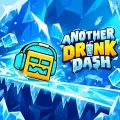
We developed Another Drink Dash at slope3.com as our own glowing passage through an imagined desert of shapes. A turquoise square and its gold-flecked trail stand against violet mesas, while pointed hazards and stacked blocks interrupt the path in electric colors. We chose that strong contrast so the landscape has atmosphere without hiding the next shape you need to react to. The real-world interplay of light, space, and land offers the creative idea; the game turns it into a moving arcade challenge.
Story
Beyond the last violet mesa, a roadside drink stand keeps one small light burning. The night traveler waiting there has asked for one last drink before the sign goes dark. Across the flats, a tiny turquoise courier sees the distant glow and sets out along a pale line that cuts through the desert. There is no broad highway, only a narrow way forward and a sky full of strange color.
As the courier races on, green and magenta points rise like warning markers. Dark spikes blend into the ground. Farther ahead, block towers gleam with cold blue edges, and suspended shapes turn an open stretch into a tight passage. White pinpricks wink in the distance. They might be friendly lights from the stand, or they might be reflections among the rocks. The courier cannot stop to decide. Every new stretch asks for another brave move.
A missed jump sends the little messenger's hopes tumbling, but the promise at the end of the road is still there. With each fresh dash, the glowing path becomes a little more familiar. The story's prize is simple: make it past the final obstacle while that last welcoming light still shines. It is a small nighttime errand made enormous by the desert between here and there.
Gameplay
Your turquoise square moves forward automatically along the course. Make it jump over ground spikes and clear solid obstacles as the track scrolls past. A collision with a dangerous object ends the attempt; in Normal Mode, the next attempt starts from the beginning. Keep the square moving safely to the far end of the course to complete the level. That is the core of Another Drink Dash: watch the next hazard, act, land safely, and keep going.
Figure 3. The turquoise square travels beside the pale track line against a shadowy violet landscape.
Your Square and the Running Ground
The runner is a little rounded square with a bright turquoise rim and yellow-orange details inside. It tilts as it leaves the ground, then lines up with the track again. Small golden square flecks follow behind it as a visual trail. They mark its motion rather than forming a collection task. A thin white or lilac line traces the running surface above dark rectangular floor tiles.
Figure 4. The tilted turquoise runner rises near a bright green triangular spike.
The ground changes appearance as you travel. Early stretches use a slim glowing edge over nearly black tiles; later sections reveal brighter violet stone-like blocks beneath the route. You still need to judge where the square can pass, especially when pointed hazards or structures break up the clear space ahead.
Spikes, Gaps, and Block Obstacles
The most immediate threats are upright triangles on the track. Some are lime green, hot pink, dark blue, or cyan, but their different colors do not change the rule: avoid every pointed spike. Near-black triangular wedges are dangerous too, even though they sit closer to the color of the ground. A simple early move is to jump before a colored point reaches the square, clear its tip, and return to the running line.
Figure 5. A vivid magenta spike interrupts the pale running line as the square moves above it.
Figure 6. Near-black triangular spikes rise from the dark stretch of track.
Later passages introduce short magenta pedestals with pointed roofs and purple centers. These are solid obstacles, not pickups. Violet square blocks with glowing cyan edges and inset geometric patterns are dangerous on contact. Some blocks form ground clusters; others hang in fixed vertical stacks above the path. You need to avoid the structures themselves, including overhead hazards as the route becomes more crowded.
Figure 7. Two magenta roof-topped pedestals stand beside the track in a brighter section.
Figure 8. Patterned violet blocks form ground obstacles and fixed hanging columns.
Jump across gaps in the ground. Falling into a gap ends the current attempt. During Ship sections, control your flight height to avoid solid obstacles above and below you. Touching the invisible ceiling also ends the attempt. The three dark square bays outlined beneath the bridge-like block formation are simply part of that structure's pattern. Likewise, the short row of tiny pink outlined squares beside larger blocks is decoration. Focus on clearing the real hazards and keeping enough room to pass through each stretch.
Ship Form and Glowing Markers
The course also includes a Ship form. When the moving character crosses a Ship portal, it transforms automatically, and you switch from timing jumps to controlling flight height. Sustained input matters while flying, since the route can place dangerous shapes above and below the available space. There is no separate button for changing form; crossing the portal triggers it.
White disks with two dark eye-like dots act as visual indicators along the route. Plain glowing white dots serve as visual markers too. Faint lavender outline circles and tighter bullseye-shaped rings are light effects. They add texture and reference points to the scene without granting a collectible reward or special power.
Figure 9. A cyan ground spike and a bright concentric-ring effect stand out against the night sky.
Finishing, Progress, and Another Attempt
A long bar with a yellow outline sits near the top center of the screen. Its cyan fill tracks how far you have traveled from the start toward the finish, so it is a distance-progress indicator rather than a points counter. Reaching the end completes the level; there is a definite finish to aim for rather than an endless run. The immediate achievement is making it through the entire obstacle course.
Hitting a dangerous obstacle in Normal Mode ends that run and sends the next attempt back to the starting point. The large attempt label, such as 'Attempt 2,' tells you which try you are on, and a new game resets that count. In Practice Mode, a placed checkpoint lets you resume there after a collision, so you can work on a difficult stretch without repeating the whole beginning. The current attempt still ends when you hit a hazard; Practice Mode changes where you restart.
Figure 10. The large attempt label shows the numbered try near the upper left of the screen.
An advertisement screen may appear between failed attempts. It shows a short countdown before a green CLOSE button allows play to continue with a new run. The upper right also has a circular pause symbol, while a small blue 'info' tab rests along the left edge. Those interface elements stay visually separate from the hazards you must avoid on the course.
Figure 11. A dark inter-attempt advertisement overlay displays a continuation countdown.
Figure 12. A green CLOSE button appears on the dark advertisement screen.
Visual Style
Another Drink Dash uses a side-on, flat geometric view with a deep purple night sky. Layered ridges and mesa-like silhouettes fade toward the horizon, while thin dark spires suggest hardy plants or distant poles. Broad, faint curves sweep across the sky. The scene feels wide and still even when the square is rushing along the narrow line in the foreground.
The brightest colors belong to things you need to notice: the turquoise runner, its yellow trail, the hot-colored spikes, and the blue-edged violet blocks. We keep the distant scenery subdued so each new outline reads clearly when it enters the path. Pointed triangles have sharp silhouettes, while large patterned blocks form heavier barriers. Small white disks and rings add visual rhythm without crowding the route.
Standout Features
The forward-moving square makes each obstacle a quick decision. Instead of steering freely through an open map, you watch the approaching track and choose when to jump. Changes in spike color keep the desert vivid, but the avoidance rule stays consistent. Larger fixed blocks and overhead stacks then ask you to read both the floor and the space above it.
The switch from Cube to Ship form adds a second kind of challenge within the same journey. A jump asks for a timely action; a flight passage asks you to manage height with continued input. Normal Mode emphasizes reaching the finish in one clean run, while Practice Mode's checkpoints help you learn an awkward section before returning to a full attempt.
If you enjoy other geometric obstacle games, the similarities are easy to place. Geometry Dash features levels built around an icon navigating obstacles, including auto-scrolling courses. [6] The Impossible Game uses a one-button cube challenge with spikes and pits. [7] Another Drink Dash brings its own violet desert setting, multicolored triangular hazards, block formations, and portal-triggered flight to that immediate, try-again style of play.
Visit slope3.com to play Another Drink Dash and take the glowing road all the way to its finish.
Controls
PC Controls
1. While the turquoise Cube moves forward, click the left mouse button, press Space, or press the Up Arrow key to make it jump.
2. When the Cube crosses a Ship portal, it automatically changes into a Ship. Hold the left mouse button, Space, or the Up Arrow key to adjust the ship's flight height. Release the input to stop applying that flight control.
3. In Practice Mode, press Z to place a checkpoint at your current position. After a failed practice attempt, you return to the placed checkpoint.
4. In Practice Mode, press X to remove the current checkpoint.
5. Press Esc to pause the game.
Mobile Touch Controls
1. On the mobile game screen, tap while the turquoise Cube runs forward to make it jump.
2. After crossing a Ship portal, touch and hold the screen to apply continuous flight-height control. Lift your finger to stop holding.
References
[1] Neon lighting. https://en.wikipedia.org/wiki/Neon_lighting
[2] Light and Space. https://en.wikipedia.org/wiki/Light_and_Space
[3] Site-specific art. https://en.wikipedia.org/wiki/Site-specific_art
[4] Land art. https://en.wikipedia.org/wiki/Land_art
[5] Minimum-contrast dominate visual search on complex-color background. https://doi.org/10.1109/caidcd.2010.5681248
[6] Geometry Dash. https://en.wikipedia.org/wiki/Geometry_Dash
[7] The Impossible Game. https://en.wikipedia.org/wiki/The_Impossible_Game
Image Credits
Dan Flavin, Untitled (to Don Judd, Colorist) 1–5 (1987), Tate Modern, London, UK.jpg - Grand Parc-Bordeaux, France from France - ccby2.0. https://commons.wikimedia.org/wiki/File:Dan_Flavin,_Untitled_(to_Don_Judd,_Colorist)_1%E2%80%935_(1987),_Tate_Modern,_London,_UK.jpg License: https://creativecommons.org/licenses/by/2.0
Self Described and Self Defined (1965) - Joseph Kosuth (1948) (24010621475).jpg - Pedro Ribeiro Simões from Lisboa, Portugal - ccby2.0. https://commons.wikimedia.org/wiki/File:Self_Described_and_Self_Defined_(1965)_-_Joseph_Kosuth_(1948)_(24010621475).jpg License: https://creativecommons.org/licenses/by/2.0