How to Play Traffic Rider?
- Desktop / Laptop: Use the left/right arrow keys (or on-screen steering buttons) to change lanes, and hold the accelerator button to control your speed.
- Mobile / Tablet: Tap and hold the throttle button to accelerate, then tilt your device or tap the on-screen arrows to steer between lanes.
Basic Information About Traffic Rider
Traffic Rider is a first-person motorcycle racing game built around a simple but addictive idea: ride through endless highway traffic, overtake as many vehicles as possible, and avoid crashing.
Rather than racing against opponents on a closed track, the game puts you directly behind the handlebars, weaving through real traffic flow at increasing speed. The combination of a first-person camera, authentic engine audio, and constant near-misses gives the game a tension that few other endless racers manage to recreate.
A First-Person Riding Experience
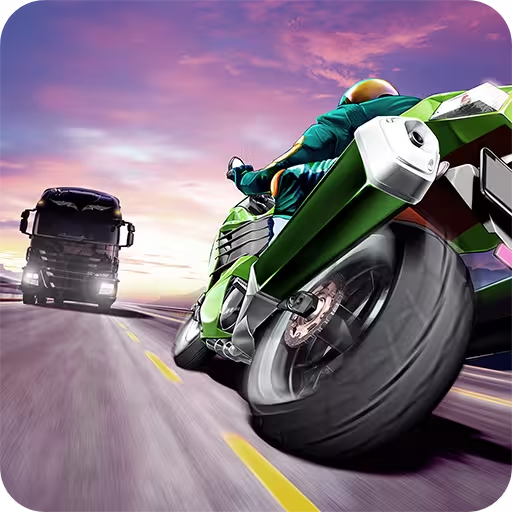
What sets Traffic Rider apart from most arcade racing games is its point-of-view camera. Instead of watching your bike from behind, you see the road exactly as the rider would — handlebars in view, traffic rushing toward you, and every lane change happening right in front of your eyes.
This perspective makes the game feel faster and more immersive than it actually is, since your brain reads incoming traffic the same way it would on a real road. It also means your reaction time matters more than in a typical third-person racer.
Authentic Engine Sound
Traffic Rider is well known for the realism of its motorcycle engine audio. Every bike in the game has its own distinct sound, and the pitch rises and falls with your RPM and gear changes exactly the way a real engine would.
This isn't just background noise — the sound gives you feedback about your speed and acceleration without needing to look down at the dashboard, which matters when your eyes should stay on the road ahead.
Sound and Speed Work Together
A good racing game does more than simply play engine noise under the gameplay. In Traffic Rider, the rising pitch of the engine as you accelerate gives you a physical sense of how fast you're actually going, especially during high-speed overtakes where a split-second reaction is the difference between a close call and a crash.
Listening for gear shifts and engine strain becomes a habit after enough playtime, and many players find themselves instinctively backing off the throttle the moment the engine "feels" too fast for the traffic ahead.
Gameplay and Difficulty
The core gameplay of Traffic Rider is about reading traffic patterns, judging gaps between vehicles, and deciding when it's safe to overtake. The road is designed to be readable — most vehicles move predictably in their lanes, which means many dangerous situations can be spotted a second or two before they become a problem.
Two-Way Traffic Raises the Stakes
Some stretches of road put you on a two-way highway, where oncoming traffic shares your lane. Drifting into the opposite lane for too long — or misjudging a pass — results in an instant head-on crash, unlike a same-direction collision, which usually just slows you down.
This mechanic rewards players who can commit to a decision quickly rather than hesitating in the middle of the road, and it's the main source of tension in an otherwise straightforward driving loop.
Endless, Career, and Time Trial Modes
Traffic Rider doesn't rely on a single format to create difficulty. Endless mode simply asks you to survive and rack up distance and overtakes for as long as you can, while Career mode introduces specific missions — reach a target distance within a time limit, chain a combo of overtakes, or survive a stretch of two-way traffic — each with its own gold-star target for players who want more than just a passing grade.
Visuals Can Become a Distraction
Traffic Rider's tracks span highways, cities, deserts, and snowy roads, each available in both day and night versions. The variety keeps repeated runs feeling fresh, but it also changes how much reaction time you actually have.
Night Routes Demand More Attention
Night tracks look great, but headlights and streetlights can make it harder to judge exactly how far away an oncoming vehicle is until it's almost on top of you. A useful strategy is to focus on lane position rather than trying to identify every vehicle by sight — by the time you can tell what it is, you should already know which lane it's in.
The Motorcycle Is Your Only Vehicle
Unlike games that switch between multiple playable vehicles or modes, Traffic Rider keeps you on a single motorcycle for the entire ride. This makes throttle control and steering precision the two skills that matter most.
Mastering Throttle and Lane Changes
The key to going fast without crashing is knowing when to ease off the throttle before a gap closes, rather than reacting after it's already too late. A change of lane that comes a moment too early can put you in the path of another vehicle; a change that comes too late can mean clipping the car you were trying to pass.
With practice, you'll start judging the distance to the next vehicle instinctively, the same way you would on a real road.
Rewards and Achievements
Traffic Rider gives you more to chase than just distance. Every overtake, close call, and stretch of high speed earns you cash and gold, which can be spent on new motorcycles and upgrades in the garage.
Earn Cash and Gold While You Ride
Cash builds up passively as you drive, but bonuses for overtaking, riding in the opposing lane, and hitting high speed all add up quickly. Gold is rarer and mostly comes from completing missions with a star rating, making it the main currency for unlocking premium bikes.
Unlock and Customize New Bikes
As you earn cash and gold, new motorcycles become available in the garage, each with different handling, top speed, and sound. Trying out a new bike often changes how a familiar track feels, since faster bikes leave far less room for error when overtaking.
Survive as Long as You Can
There's no traditional finish line in Endless mode — the real objective is to keep riding, keep overtaking, and keep your combo alive for as long as possible before a single mistake ends the run. In Career mode, completing each mission's distance or time target is what counts as reaching the finish line.